An Aerospace & Defense assembly begins long before the first component reaches a machine or welding station. It begins with decisions about geometry, material, tolerances, joining and verification. Those decisions influence how the work can move through production. When manufacturing questions remain unresolved, the drawing may be complete while the production plan still contains uncertainty. Design for manufacturability, or DFM, creates an opportunity to address that uncertainty while the team can still evaluate alternatives.
Start With the Requirement
A useful DFM conversation begins with what the assembly must do. Which interfaces control fit? Which features affect function? What material condition is required? What customer specifications govern the work? For an Aerospace & Defense manufacturing fixture, the discussion might include locating surfaces, repeatable positioning and access for the operator. For flight hardware, the applicable technical and quality requirements may be different. The review should follow the actual application rather than assume every Aerospace & Defense item carries identical requirements.
At Advance Welding, DFM and engineering belong in the same conversation. Design intent needs a practical manufacturing route, and that route needs a clear understanding of the design. Early collaboration helps identify questions that should be resolved with the customer before fabrication, machining or joining begins. It also provides a place to distinguish a necessary requirement from a feature that may be adding avoidable manufacturing difficulty.
Look Beyond an Isolated Operation
Consider a hypothetical welded assembly with a tightly controlled mounting interface. The machining plan might appear straightforward when each detail is viewed separately. Once assembled, however, the team also needs to consider joint access, fixture clearance, the welding sequence and how the final interface will be measured. A decision made to simplify one operation could make the next operation harder. Reviewing those relationships early gives the team a better basis for choosing a workable route.
NASA has described the value of involving design, materials, welding, manufacturing and inspection personnel as a welded design develops. That principle is relevant beyond spaceflight: people responsible for making and verifying the assembly should help evaluate whether the design can be produced and inspected. It does not transfer design authority away from the customer. Proposed changes still require the appropriate review and approval.
Make the review specific
Useful questions include whether the joining equipment can reach the joint, whether the fixture supports the intended sequence and whether inspection can access the required features. The team should also discuss datums, material identification and which dimensions matter before and after joining. These are practical questions about executing the work. They help turn a broad request for manufacturability into a focused review of the assembly and its production requirements.
 Engineering then connects those findings to a proposed process. The discussion can address sequencing, workholding, intermediate checks and the information needed to proceed. Some projects will require development work before a production approach is established. Others may be ready for a defined manufacturing route once a few drawing questions are answered. The objective is to identify those needs explicitly, without promising that every design can be simplified or every uncertainty eliminated.
Give Purchasing a Clearer Starting Point
DFM also matters to sourcing teams. An early conversation can expose scope gaps that make quotations difficult to compare. Does the request include the complete assembly or only a joining operation? Who supplies material? Which records accompany the finished work? Are special processes or outside services required? Clear answers help purchasing evaluate the proposed scope alongside price and schedule, rather than discover missing responsibilities after an order is placed.
A productive first discussion does not require a polished presentation. Start with the application, current design maturity, known manufacturing concerns and the desired delivery window. Identify which requirements are fixed and which questions remain open. If technical files are needed, arrange the appropriate transfer method with the project team. That allows the conversation to progress with the right people and the right information.
For repeat programs, the review can also identify what must remain consistent when quantities or configurations change. Document the assumptions behind the proposed route so future discussions begin with a shared understanding of the work.
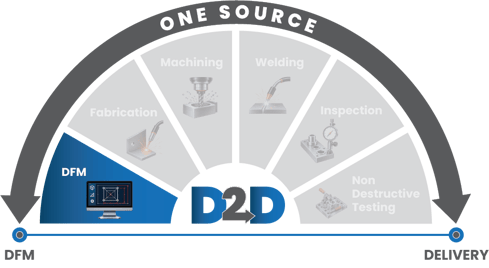
Put the First D2D Connection to Work
 Design 2 Delivery starts by connecting what the customer needs with how the work will be made. DFM and engineering establish that connection before subsequent operations depend on it. If your Aerospace & Defense project has unresolved questions about weldability, workholding or production sequence, contact Advance Welding to discuss a DFM review. Begin with a project overview and the decisions your team needs to resolve.